
Cash on Delivery (COD) in Europe: complete guide for online stores
Cash on Delivery (COD) in Europe: the complete guide for online stores
Cash on delivery (COD) is still the payment method that converts the most browsers into buyers across large parts of Europe. For online stores selling supplements, cosmetics, food, fashion or consumer goods into Romania, Bulgaria, Greece, Serbia, Slovakia, Hungary, Poland, Czechia or the Baltic countries, COD is not optional — it’s the default. Yet many merchants still struggle to make COD work end-to-end: choosing the right courier, reconciling cash, handling refused parcels, and getting paid out reliably.
This guide collects the essentials in one place: which European countries support COD, the operational flow from packed parcel to payout, common pitfalls, the metrics that matter, and how to pick a fulfillment partner that has already solved the operational details.
What is cash on delivery?
Cash on delivery (sometimes shortened to COD or наложен платеж in Bulgarian) is a payment method where the end customer pays the courier directly when the parcel is delivered — in cash, by card on the delivery handheld, or by bank-transfer slip captured at the door. The courier collects the funds on behalf of the merchant, and the money is paid out to the merchant’s bank account on a scheduled cycle (usually weekly or twice-weekly).
For the customer, COD removes a significant trust barrier: they don’t pay until the box is in their hands. For the merchant, COD opens up segments of the market that would otherwise never buy online — older customers, customers without cards, customers worried about online fraud, and customers in regions where card adoption is uneven.
Which European countries support COD in 2026?
From the warehouses we operate at BigArena Fulfillment, cash on delivery is currently supported in 24 European countries, including:
- Bulgaria — via Speedy, Econt, Pigeon Express, GLS
- Romania — via Cargus, Fan Courier, Sameday, GLS
- Greece — via ACS, Geniki Taxydromiki
- Hungary — via GLS, Packeta, DPD
- Serbia — via D Express, AKS Express, Posta Srbije
- Slovakia — via Slovak Parcel Service, Packeta, GLS
- Czechia — via Packeta, PPL, GLS, DPD
- Poland — via InPost (Paczkomaty), DPD, GLS
- Croatia, Slovenia, Bosnia & Herzegovina — via local GLS partners and OVERSEAS
- Lithuania, Latvia, Estonia — via Omniva, DPD, Venipak
- Cyprus, Malta, Ireland — via dedicated COD agreements
- Germany, Austria, Italy, Spain, Portugal
Each market behaves differently. Bulgaria, Romania and Greece sit at the top end of COD adoption (40–60% of all ecommerce parcels in some verticals). The Baltics use COD selectively. Western markets like France or the Netherlands have very limited COD — card or wallet payment dominates there. A serious ecommerce fulfillment partner will know exactly which couriers do COD reliably in which country and how each one settles funds.
The COD operational flow
Every COD parcel goes through six predictable steps. Knowing this flow lets you spot failures fast.
- Order placed — The customer selects COD on the online store. The order arrives in the fulfillment system with the COD amount and customer details.
- Picked, packed and labelled — The warehouse picks the SKUs, packs the parcel and prints the courier label with the COD amount, recipient and store IBAN encoded into the waybill.
- Handover to courier — The parcel is scanned at handover. From this moment the courier holds the legal responsibility for collecting the COD amount.
- Delivery and collection — The courier delivers, accepts payment (cash, card or bank), and marks the COD as collected in their system.
- Reconciliation — The fulfillment partner reconciles delivered parcels with collected amounts — flagging anything that says “delivered but not paid” or vice versa.
- Payout to merchant — On the scheduled cycle (at BigArena you choose it in the panel, from once a month up to daily; in Romania up to twice a week), the courier transfers the collected funds to the merchant’s bank account, with a deduction file showing which parcels are included.
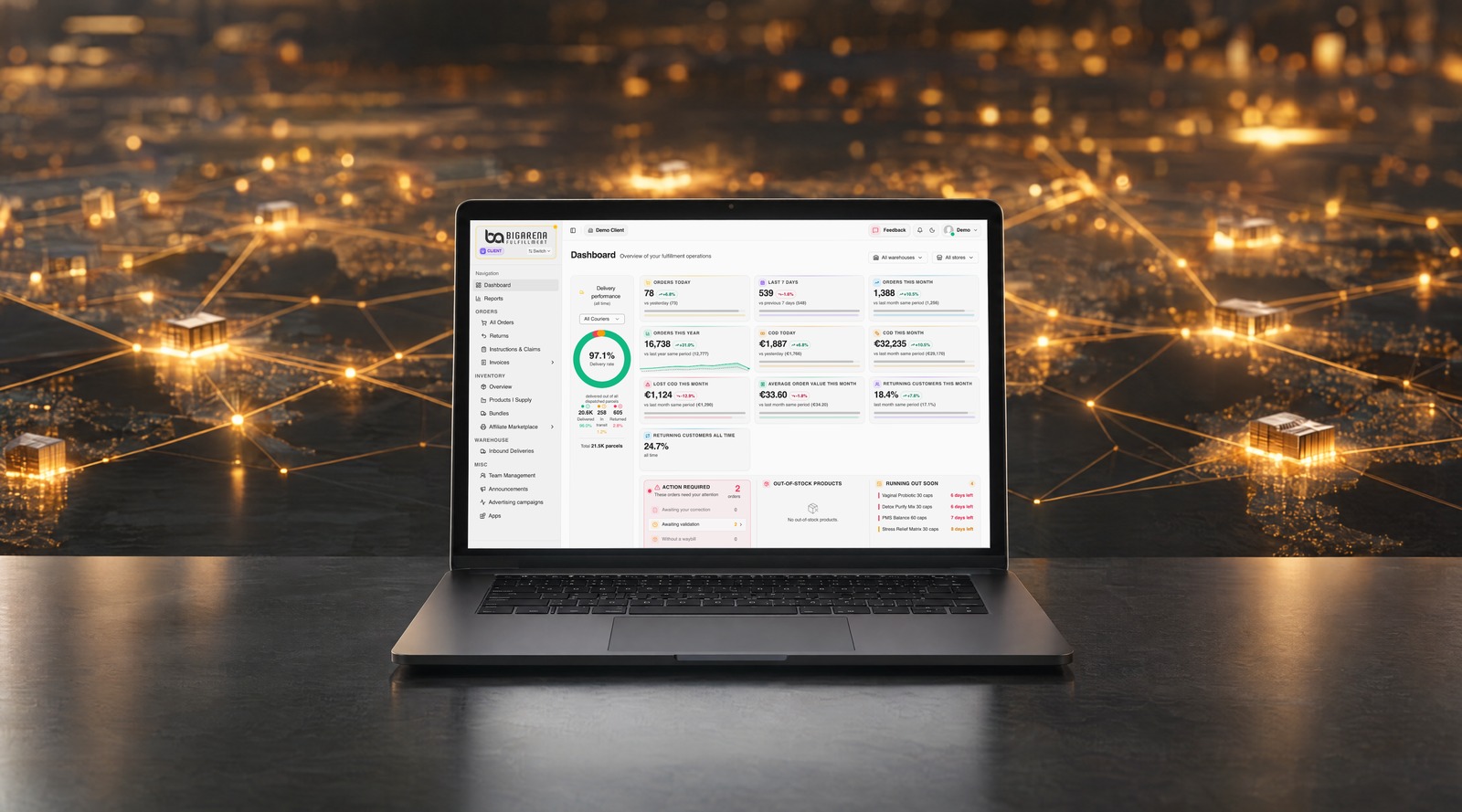
At BigArena Fulfillment we reconcile every COD parcel in our WMS dashboard within 24 hours of delivery, so merchants always see the up-to-date status of delivered, delivered & collected, refused and returned.
COD success rates — what is realistic?
The single biggest concern of merchants new to COD is the refusal rate. Customers can change their mind, not be home, or simply not have cash. Realistic ranges, based on tens of thousands of monthly parcels through our fulfillment centers:
- Bulgaria: 92–97% successful delivery for supplements, cosmetics and food; 88–94% for fashion (higher refusal on size fit).
- Romania: 90–95% on supplements; 86–92% on fashion; 80–88% on electronics over €200 (higher reluctance on expensive items).
- Greece: 88–93%, often boosted by SMS confirmation prior to dispatch.
- Serbia, Slovakia, Czechia, Hungary, Poland: 85–92%.
Three operational levers move the success rate up materially:
- Pre-dispatch confirmation — A call-center confirmation call before the parcel ships eliminates fake orders and customers who already changed their mind. We see a 4–7 percentage-point improvement on supplements campaigns when confirmation is enabled.
- SMS notifications in the local language — reminding the customer that the parcel is out for delivery on day X.
- Address quality — auto-fixing common typos (missing apartment, wrong postal code) at the warehouse before label printing.
Common COD pitfalls and how to avoid them
Payout delays
Couriers occasionally hold funds longer than agreed — especially around bank holidays or sudden volume spikes. Mitigate by working with a fulfillment partner that has multi-courier COD agreements, so payouts come from several sources rather than one bottleneck.
Failed-delivery returns piling up
Every refused COD parcel becomes a return. Without a fast process, returns sit in the warehouse, blocking valuable inventory. We process returns into stock within 2 business days — see the returns handling section for the SLA.
Currency and VAT
For cross-border COD inside the EU, the courier collects in the destination currency. The merchant receives funds either in the destination currency or converted to EUR, depending on the partner agreement. VAT obligations follow OSS rules — speak to your accountant about thresholds.
Cash handling fees
Couriers charge a small fee per COD parcel (typically €0.30–€0.60) on top of the standard shipping rate. Build this into your unit economics from day one rather than discovering it after the first month.
How to choose a fulfillment partner for COD-heavy markets
Not every 3PL or fulfillment center handles COD competently. When evaluating partners for COD markets:
- Ask which couriers they have COD agreements with in each target country — specific names, not “all major couriers.”
- Ask for the payout cycle in each country, including how holidays affect it.
- Ask for the reconciliation SLA — how soon after delivery does the merchant see the status?
- Ask for documented refusal-rate benchmarks for your product category.
- Ask whether they can run pre-dispatch confirmation calls in the destination language.
- Ask whether returned COD parcels are inspected and put back into sellable stock automatically.
If a fulfillment provider can answer all six clearly, you have a partner. If they hedge, look elsewhere.
Ready to launch COD across Europe?
BigArena Fulfillment operates from eight warehouses across Europe with COD support in 24 countries, 40+ courier integrations and full reconciliation in our WMS. Whether you are starting from zero or migrating from a current 3PL, we can have you live with COD in 2–4 weeks.
See our European fulfillment service or request a personalized quote for your COD volumes.
See also
- What is a 3PL in e-commerce - how third-party logistics works in practice
- How fulfillment services save time and resources - operations efficiency breakdown
- Advantages of the fulfilment service - UK-spelling guide to the service category
- Fulfillment solutions from BigArena - overview of our service stack